Deposition Transcript Errata Deadlines: A Practical Guide to the Deposition Transcript Correction Process
· TrialBase
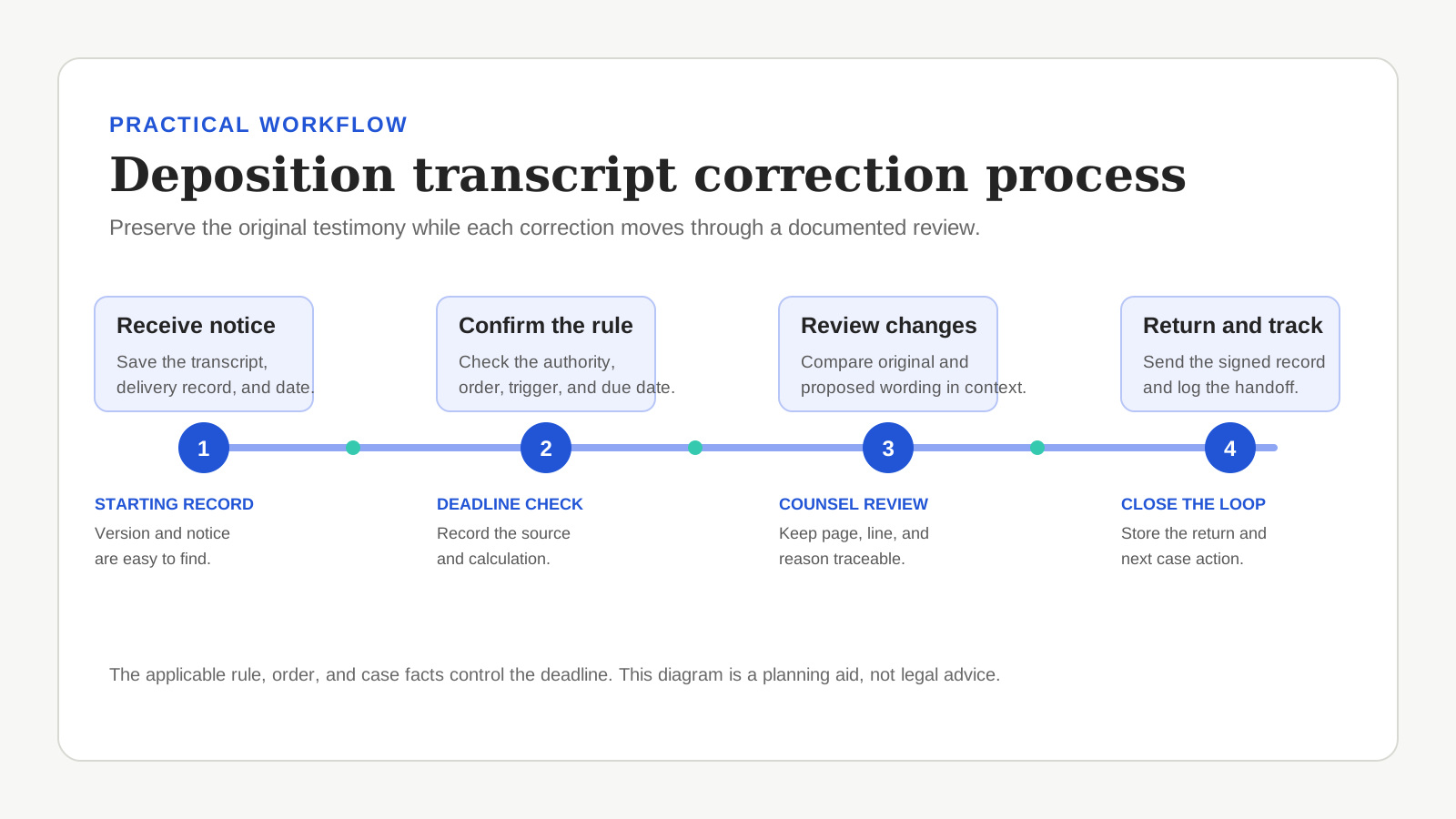
The deposition transcript correction process can affect how a witness’s testimony is used in a personal injury case. The deadline and permitted changes depend on the governing rule, court orders, and case circumstances, so counsel should verify the applicable requirements rather than assume one timeline applies everywhere. This guide focuses on practical steps a plaintiff-side firm can use to track the transcript, review proposed changes, and preserve an accurate record.
Explore deposition transcript tools
What does the errata process do?
After a deposition, the court reporter prepares a transcript. Where the applicable procedure allows review, the witness may be asked to read and sign the transcript and identify corrections on an errata sheet. The process captures changes the witness requests; it does not replace reviewing testimony in context or checking procedural rules. The original answers remain part of the history of the testimony, even when a witness proposes a correction.
For a plaintiff-side firm, the work is broader than obtaining a signature. The team needs to know when the transcript became available, who received notice, what deadline applies, whether an order or agreement affects review, and how a requested correction is recorded and returned. A missed deadline or incomplete record can create avoidable disputes when testimony matters to liability, causation, or damages.
Think of the work as two linked tracks. The procedural track establishes whether review is available and what steps must be followed. The case-preparation track preserves the original testimony, identifies the proposed change, and lets counsel evaluate its significance. Keep both tracks connected, but do not let a document-management task decide a legal question.
It helps to separate three questions that are often blended together: may the witness review the transcript under the applicable procedure; what formal steps are required to submit a correction; and what effect, if any, does a proposed change have on the evidence or case strategy? The first two are rule-and-order questions. The third calls for legal analysis of the complete record. A signed errata sheet is not itself a finding that a change is valid, accepted, or persuasive.
How do you determine the deadline?
Start with the authority governing the deposition. In a federal civil case, Federal Rule of Civil Procedure 30(e) may be relevant. State rules, local rules, scheduling orders, stipulations, and case-specific directions can differ. Read the applicable text rather than relying on a firm-wide assumption or a deadline copied from another file. The event that starts the period also matters: a calendar entry that says “30 days after deposition” may be inaccurate if the applicable trigger is a later notice that the transcript is available.
The American Bar Association article Preventing Errors in the Errata Process notes that the 30-day period discussed there runs from notification by the court reporter that the transcript is available. Treat that as a prompt to verify the governing authority and its trigger in your matter, not as a universal deadline for every jurisdiction or case. The article does not replace the rule, order, or counsel’s review in a particular case.
Use a source hierarchy to confirm timing and document what you checked:
- Identify the court and jurisdiction, then locate the rule that applies to this deposition.
- Review any scheduling order, stipulation, or case-specific direction that may change the procedure.
- Find the precise trigger in the governing text. Preserve the notice, delivery email, or other record establishing that event.
- Apply the relevant time-counting rules, including any provisions about weekends, holidays, or service, rather than calculating from memory.
- Record the source, trigger date, calculated due date, reviewer, and person responsible for the next action. Have counsel confirm the calculation where there is uncertainty.
A useful deadline note states more than a date. For example: “Reporter notice received on [date]; rule reviewed: [authority]; trigger: notice of availability; due date calculated under [applicable counting rule]; attorney confirmation: [name or status].” The bracketed fields are prompts, not a substitute for applying the correct rule. This note makes later review easier if a different staff member takes over or opposing counsel questions the timeline.
Check whether the transcript notice actually establishes the event required by the rule. An email might say that a transcript is ready, attach a rough draft, provide a link to a secure portal, or refer to a final certified copy that will follow. Do not assume those events are interchangeable. Save the message and attachments as received, note whether the transcript was complete and accessible, and ask counsel to decide whether the event satisfies the relevant trigger when the wording or delivery is unclear.
Do not treat an internal reminder as the legal deadline. Set an internal date early enough to leave time for review, but label it clearly as an internal target. Keep the external due date, internal review date, and any witness-return date distinct. If an extension is discussed, preserve the request and response and confirm whether the extension is effective under the governing procedure. A conversation or unanswered email may not resolve the issue.
Which requirements should the team compare?
The table below is a planning aid, not legal advice. It identifies questions to answer before sending a transcript for review. It does not state that every jurisdiction uses the same form, deadline, or procedure. Confirm the actual requirements in the governing authority before acting.
| Question | What to verify | Why it matters |
|---|---|---|
| Does the procedure allow review? | Check the governing rule, stipulation, and court order. | Do not assume every deposition includes the same review process. |
| What starts the period? | Find the trigger and retain the notice or delivery record. | The deposition date may not be the trigger. |
| How long is the period? | Use the applicable text and time-counting rule. | Different authorities and orders can produce different dates. |
| How must corrections be presented? | Confirm form, signature, reasons, service, and return method. | Incomplete submissions can lead to disputes. |
| What happens to the transcript? | Check requirements for certification, attachment, and use of the original and changes. | Keep the testimony and proposed corrections traceable. |
| Who receives the materials? | Confirm who must be served or notified and by what method. | Sending only to one recipient may not complete the required step. |
| What if an item is disputed? | Identify the person who will decide whether to seek guidance or take another step. | A disputed issue should not disappear into a closed administrative task. |
Use the table as a matter-specific checklist, not as a substitute for reading the source. For example, a team may confirm that review is permitted and still need to answer whether the witness must state reasons, where the errata sheet must go, and whether the transcript is to be signed or returned in a particular way. Those details may be located in different provisions or in an order. A tracker should point to the source or saved document, not just say “rule checked.”
What should counsel and staff do when the transcript arrives?
A clear intake workflow reduces the chance that a deadline is buried in an email thread. Assign one operational owner for the transcript and calendar entry, while reserving legal decisions about the procedure and proposed changes for counsel. If several depositions are active, use the same intake fields so a supervisor can spot missing information quickly.
- Preserve the receipt. Save the reporter’s availability notice and the original delivery message with the transcript.
- Confirm the matter. Match the transcript to the case, deponent, deposition date, and any associated exhibits.
- Identify the rule source. Note the court, applicable rule, any order or agreement, and who verified them.
- Calendar a verified deadline. Record the trigger and calculation source. Add an internal review date early enough to allow the witness and counsel to address questions.
- Send the correct review copy securely. Give the witness neutral instructions and the verified due date. Do not suggest what the testimony should say.
- Track the return. Log when the signed transcript or errata sheet arrives and how it was delivered.
- Confirm completion. Determine whether the rules require service, filing, or return to the reporter, and retain proof of the required step.
For several open matters, a shared tracker can include case identifier, deponent, deposition date, transcript status, notice date, rule source, deadline, attorney reviewer, witness delivery date, return date, and outstanding action. A status such as “awaiting witness” is more useful when paired with an owner and next check-in date. Limit access to people who need the case material and follow firm confidentiality and retention practices.
Consider a sample handoff. A paralegal receives a transcript and reporter notice while the responsible attorney is in court. The paralegal saves both files, checks that the notice identifies the right witness, creates an intake task, and flags the governing rule for attorney confirmation. The paralegal should not convert an unverified date into a final deadline or tell the witness which answers to change. Once counsel confirms the procedure and due date, the team can send neutral instructions and set reminders for delivery and return.
Make the intake itself observable. A task marked “transcript received” should show whether the file opens, whether it includes the expected pages and exhibits, and whether the notice names the correct deponent. If a link has expired or a transcript is incomplete, record the issue and request a usable copy. Do not let the first staff member’s download become the only copy. Save a firm-controlled copy in the approved matter location and preserve the original message so the team can reconstruct when and how it arrived.
Use two owners for different kinds of work. The operational owner manages receipt, file naming, reminders, and proof of delivery. The attorney reviewer confirms the applicable procedure, resolves legal questions, and decides how proposed substantive changes should be handled. A backup should be named for absences, but the backup should not have to infer what the first owner was doing. Add a brief handoff note stating the completed steps, open questions, next action, and date for checking status.
How should a witness review testimony?
Ask the witness to read the transcript carefully against their recollection and the questions asked. The witness should identify a proposed correction accurately and explain the reason in the manner required by the governing procedure. Counsel should not turn review into an effort to rewrite inconvenient testimony. Clear, neutral directions help distinguish a witness’s own requested correction from wording supplied by someone else.
Separate an apparent transcription issue from a substantive change. A misspelled name, a misheard word, or a passage that does not reflect what the witness recalls saying may call for a different analysis than a change to a date, sequence, distance, or description of an injury. In a personal injury matter, a proposed change to the timing of symptoms or the events surrounding a collision may be important to causation or credibility. Calling a change a “clarification” does not determine whether the procedure permits it or what effect it may have.
For each proposed entry, check the page and line reference, quote enough of the original text to identify it, state the requested replacement, and include a reason if required. Keep the witness’s explanation intact. Do not silently edit the transcript file or overwrite the original with a new version. If the witness is unsure whether a line is accurate, record the question and ask counsel how to proceed instead of guessing.
Counsel can use a consistent review sequence: read the surrounding question and answer, compare the proposed correction with the transcript and any relevant record, determine whether it is a transcription issue or substantive change, and assess the applicable procedure before deciding how to respond. A medical record or other document may help identify a factual issue, but it does not authorize staff to steer a witness toward a particular answer. Preserve the source for each comparison and avoid putting privileged analysis in a shared administrative tracker.
Give the witness an easy-to-follow packet. It can include the review copy, neutral written instructions, the verified return date, a clear method for asking questions, and any form required by the applicable procedure. Explain that the witness should read the full transcript and flag requested changes rather than alter pages without explanation. Avoid leading examples that suggest which testimony should change. If the witness has difficulty reading, needs a different format, or raises a question about an answer, route that issue to counsel and document the practical accommodation or follow-up without supplying a factual response.
When the transcript is long, a witness may be tempted to skim it or focus only on passages identified by the legal team. The firm can make careful review more manageable by dividing the copy into clearly identified sections, setting a reasonable return plan consistent with the deadline, and asking the witness to note questions as they arise. The process should not imply that the witness must adopt the firm’s interpretation of a document or memory. The task is to identify what the witness believes is accurate and to handle any proposed changes under the governing procedure.
How can the team distinguish types of proposed corrections?
A correction log can make review easier without predetermining the legal significance of an entry. Use neutral categories to describe what the requested change appears to concern. The category is an organizational aid; counsel still needs to read the full testimony, the witness’s reason, the applicable procedure, and any relevant evidence.
- Spelling or identity detail: A name, street, employer, or other proper noun may have been transcribed incorrectly. Confirm the intended spelling from an appropriate source when available, while retaining the witness’s stated reason.
- Transcription or punctuation question: The witness may report that a word was misheard or that a sentence does not reflect what was said. Compare the audio or reporter materials only if available and authorized, and do not assume that an audio file exists.
- Memory or precision change: A witness may seek to change an estimate, date, distance, sequence, or description. Preserve the exact original and proposed wording and flag it for counsel’s review.
- Context or explanation request: A witness may ask to add context to an answer. Do not silently insert an explanation into the transcript. Record the request and have counsel assess the appropriate treatment.
- Unclear or incomplete entry: A correction may lack a page-line reference or reason, or the witness may identify a passage without proposing language. Return the question to the witness through a neutral process or ask counsel what further information is appropriate.
This simple classification helps staff notice patterns. Several proposed name corrections may need a different operational check than a group of changes to the timeline of an accident. But a category should never be used as a shortcut for deciding admissibility, credibility, or whether an entry is permitted. Write “substantive change for attorney review,” not “invalid,” “harmless,” or “accepted,” unless counsel has directed that conclusion and the record supports it.
Consider a hypothetical collision deposition. The witness requests a spelling correction to a road name, changes an estimate of how long a traffic signal was visible, and adds that pain began later that evening rather than immediately after impact. Those entries raise different review questions. The spelling may be checked against a reliable source. The estimate and symptom timing should be read with the surrounding questions and compared with the witness’s stated reasons and relevant case materials. The team should preserve each original answer and avoid collapsing all three entries into one generic “clarification” label.
For a premises case, a witness might correct the name of a store employee, change an estimate of how long a condition was present, or ask to expand an answer about whether the area was inspected. Again, the practical consequence may vary. A name correction could help identify a person for follow-up; a changed estimate could affect notice evidence; an added explanation could change the apparent scope of an answer. The attorney decides what follow-up, if any, is warranted. Staff’s role is to keep the entries complete, traceable, and routed to the right reviewer.
How should counsel evaluate a substantive change?
A proposed change to a material answer deserves careful review, not an automatic rejection or an automatic rewrite. Begin by placing the original answer beside the requested wording and reading the full question-and-answer exchange. Include enough surrounding testimony to understand whether the question was leading, whether the witness expressed uncertainty, and whether a later answer already addressed the same subject. A single line rarely gives enough context to evaluate meaning.
Next, identify the witness’s stated reason exactly as submitted. Does the witness say the reporter recorded the wrong word, that the answer was incomplete, that the witness remembered the event differently, or that a term was misunderstood? The reason may guide counsel’s next review, but it does not answer the procedural or evidentiary question by itself. Preserve the witness’s wording rather than translating it into a legal conclusion.
Then compare the proposed change with the record that counsel considers relevant. In an auto collision matter, that might include prior statements, photographs, vehicle data, medical records, or other deposition testimony. In a premises claim, it may include incident reports, inspection records, photographs, or testimony from another witness. These are possible sources, not a universal checklist. Decide what is relevant to the actual issue and respect the firm’s usual confidentiality and privilege controls when recording the analysis.
Use a review note that separates fact from assessment. For example: “Original: ‘I noticed the pain the next morning.’ Proposed: ‘I felt a little discomfort at the scene, but the stronger pain began the next morning.’ Witness reason: [quote or concise faithful account]. Related testimony: [page and line references]. Counsel review: pending.” That note does not conclude whether the change is proper. It gives the attorney a reliable starting point and prevents later users from mistaking a draft analysis for the witness’s original testimony.
Finally, identify the next legal or case-preparation action. Counsel may need to confirm the applicable rule, consider whether to communicate with another party, preserve a position, plan follow-up questioning where available, or keep the proposed change attached to the transcript. Which action is appropriate depends on the matter. Staff should not send a substantive explanation to opposing counsel, modify a filing, or characterize the change as accepted without attorney direction.
What documentation should the firm retain?
Keep a chronological record that lets another team member understand what happened without reconstructing it from scattered messages. Depending on the governing procedure, the file may include:
- The reporter’s notice that the transcript was available, including its date and delivery method.
- The exact transcript version sent for review and the date it was delivered.
- The rule, order, or stipulation used to determine whether and how review proceeds.
- The witness’s signed review or errata sheet and any reasons provided for changes.
- Proof of return, service, filing, or delivery to the reporter and other parties, as required.
- Correspondence about timing, extensions, disputed corrections, or missing materials.
- A brief closure note identifying the final status and where the original and corrections are stored.
Use consistent file names and version control. A practical naming pattern might include a case identifier, deponent, deposition date, document type, and version date. Keep the original transcript distinct from a review copy, a marked copy, and final errata materials. If a correction is challenged later, the team should be able to show which version was reviewed and when each item entered the record.
For example, do not name three files “final,” “final revised,” and “final latest.” Use a neutral sequence such as “case-deponent-transcript-original,” “case-deponent-review-copy-date,” and “case-deponent-errata-returned-date.” Adapt the pattern to firm policy and avoid putting sensitive personal information in a file name. Version labels should describe the document’s status, not imply that a proposed change has been accepted by the court or opposing counsel.
Keep the working notes and the formal transcript materials distinguishable. A team’s issue list may contain attorney impressions or privileged analysis. The errata sheet, by contrast, records the witness’s requested changes in the form required by the applicable procedure. Store both according to firm policy, limit access appropriately, and avoid copying internal evaluations into a document that may be transmitted as part of the formal submission. Ask counsel about questions concerning privilege or what must be disclosed.
Preserve the delivery trail as well as the document. A saved PDF alone may not show when it was sent to the witness, whether the witness received it, or what instructions accompanied it. Keep the transmission record, any return confirmation, and any later request for a corrected copy. If a secure link is used, preserve a record sufficient to establish the transaction without keeping credentials or access tokens in a general case note.
How do case-specific examples change the workflow?
The core steps stay the same, but the issue list and follow-up can differ by case. In an auto accident file, testimony about traffic signals, visibility, speed, impact sequence, and symptoms after the event may connect to separate liability and damages questions. If a witness proposes a change to the sequence of events, counsel may want to compare the full deposition passage with other accounts and physical evidence. If the change concerns a street name, the team may focus on identifying the correct location and whether the correction affects an exhibit or discovery follow-up.
In a premises matter, the relevant testimony might concern when a condition was first seen, who inspected the area, how often inspections occurred, and what the witness observed. If a proposed correction changes an estimate of duration, keep it linked to the surrounding discussion of the witness’s basis for the estimate. Do not assume a time estimate is precise if the testimony itself shows uncertainty. Counsel can decide whether the issue should inform investigation or later case preparation.
In a product liability or mass tort file, an individual deposition may sit alongside a large record set and repeated testimony topics. The team should still treat each transcript as its own record. A correction to a product name, model, or exposure description should be associated with the exact source and case, not copied automatically from another witness’s file. Shared templates can standardize intake fields, but they should not cause one witness’s facts or corrections to migrate into another matter.
These are issue-spotting examples, not a formula for every claim. The responsible attorney identifies the legal questions, selects useful comparison materials, and determines whether the proposed change affects investigation, discovery, negotiation, or trial preparation. Staff can support that judgment by preserving page-and-line references and ensuring that the version being reviewed is the one the attorney actually sees.
How can transcript analysis support case preparation?
Once the transcript and any changes are organized, the legal team can locate testimony relevant to liability, causation, damages, and follow-up discovery. Keep page-and-line references and identify the source document for each note. A summary can help a lawyer find a passage, but the attorney should return to the transcript to verify the full question, answer, context, and any attached errata before relying on it.
For a plaintiff-side auto collision case, a team might tag testimony about traffic signals, visibility, speed, impact sequence, and symptoms after the event. In a premises matter, useful topics may include notice, inspection practices, lighting, and the location of a hazard. These are organization examples, not a universal issue list; the attorney should set topics based on the claims, defenses, and evidence in that case.
TrialBase’s Deposition Summary Agent is designed for deposition transcript summaries. Review any generated output against the source transcript, especially where wording is disputed or a correction has been submitted. A summary should make it easier to navigate the record, not replace the record or decide whether a correction is procedurally valid.
Related workflows can include a deposition outline for planning questions and discovery tools for organizing other case materials. A firm evaluating technology can also review TrialBase’s security and compliance information and privacy policy as part of its own vendor review. These pages describe product and policy information; they do not determine whether a particular tool or workflow meets a firm’s obligations.
Technology can help organize, search, and summarize documents. It cannot replace counsel’s review of the governing authority, the original testimony, or the legal consequences of a proposed change. Keep a human review step before relying on analysis in a filing, negotiation, or case decision.
One useful way to scope a summary task is to define the output before processing begins. A request might ask for a chronology of testimony about the collision, a list of passages about claimed injuries, or an index of references to a particular location. Each output should preserve citations or page-line references that let the lawyer return to the source. Avoid asking a summary to resolve whether the witness was truthful, whether a correction is permitted, or what a court will do; those are not document-navigation tasks.
When corrections arrive after an initial summary has been prepared, treat the updated materials as a new review event. Keep the original summary and note which transcript and errata version it reflects. Decide whether the summary needs an update, and verify any changed passages in context. This simple version check prevents an older work product from appearing to describe the final record when it was prepared before the witness submitted proposed changes.
What common mistakes create avoidable risk?
- Starting from the wrong date. The trigger may be notice or availability rather than the deposition date. Preserve the original notice and verify the rule’s wording.
- Applying one jurisdiction’s rule to another. Confirm federal, state, local, and case-specific requirements for the matter at hand.
- Assuming every change is harmless. Review substantive changes in context and have counsel assess their procedural and evidentiary implications.
- Leaving ownership unclear. Name one person responsible for calendaring and follow-up, plus a backup for absences.
- Overwriting the original. Preserve the transcript as received alongside review copies and all correction materials.
- Relying on an isolated line. Read enough surrounding testimony to understand the question, answer, and context.
- Closing the task too early. Do not mark the workflow complete until the required return, service, filing, or documentation step is verified.
- Using an unexplained internal label. “Fixed” or “approved” can imply a legal conclusion. Use a neutral status that says who must review the entry next.
- Sending the wrong version. Confirm the witness receives the intended transcript and that returned corrections refer to the same version.
A quick quality check at closure can catch many of these problems: Is the trigger documented? Is the deadline source recorded? Are the original transcript and any errata retained? Can the team show what was sent, to whom, and when? Is there a clear note about any unresolved issue? If an answer is no, leave the task open and assign a specific follow-up rather than relying on a general reminder.
Watch for workflow drift. A checklist may start as a careful sequence and later become a set of boxes that staff mark without checking the underlying documents. A periodic review of completed matters can test whether entries such as “deadline verified” link to a real source and whether returned materials were actually saved. If a field is routinely blank, determine whether the field is unclear, responsibility is missing, or the process requires a different handoff. Adjust the system to address the cause rather than adding reminders that do not change the work.
How can a firm build a reliable deadline workflow?
A small firm does not need a complicated system to make the process more dependable. It needs a repeatable intake and verification routine that makes the source, owner, deadline, and next action visible. Start with a checklist and adjust it after the team encounters a real gap.
- Create a transcript-intake task when the reporter’s availability notice arrives.
- Assign an operational owner, an attorney reviewer, and a backup owner.
- Confirm the governing rule and any order or agreement before finalizing the due date.
- Record both the external date and an earlier internal review date, with reminders assigned to named people.
- Track witness delivery, return, and any required service or filing as separate steps.
- Close the task only after the complete record and proof of required actions are saved.
For a worked example, suppose a firm has three transcripts arriving during the same week. The team should create three separate matter records, not one generic “errata” reminder. Each record needs its own notice date, governing authority, trigger, calculated deadline, responsible attorney, and status. If one reporter’s notice is missing, flag that file for follow-up rather than borrowing the date from another transcript. Similar-looking tasks do not necessarily share the same procedural facts.
Build time for human review into the workflow. The witness may need time to read carefully, counsel may need to resolve a question about a proposed change, and staff may need to verify how materials must be returned. An internal due date should therefore precede the external deadline by enough time for the actual matter, not by an arbitrary number copied into every case. If the schedule is compressed, elevate the issue promptly and document counsel’s direction.
If the firm handles many transcripts, periodically audit a sample of closed matters. Check whether the deadline source is recorded, the right trigger was used, original versions remain available, and completion evidence is present. Track patterns such as missing availability notices or unassigned follow-ups, then revise the intake checklist to address the cause. A review of the process is more useful when it leads to a specific change, such as adding a required field or assigning a backup, rather than merely reminding staff to be careful.
For transcript analysis in a broader case-preparation workflow, review the Deposition Summary Agent and the Trial Plan Agent. Choose tools based on the firm’s actual workflow, review product information, and confirm that the process preserves source verification and attorney judgment.
What does a detailed handoff look like?
A handoff succeeds when the next person can act without reopening every message or guessing what remains. A practical handoff note can use a short, consistent set of fields: current document version; transcript notice and receipt date; rule or order source; deadline status; witness contact status; proposed corrections received; attorney questions; completed delivery or service steps; and the next owner with a specific follow-up date. Keep the note factual and link to the records instead of copying sensitive material into a broad task system.
Imagine that a case manager receives an errata sheet late in the day and notices that one page-line entry does not match the transcript pagination. The manager should save the sheet as received, record the discrepancy, and notify the designated attorney reviewer. The manager should not adjust the page reference on the witness’s behalf or silently substitute different wording. The attorney can decide whether clarification is needed and how to document the response. The task remains open until that question and all required return steps are resolved.
For a staff transition, the outgoing owner should identify deadlines that have already passed, those approaching, and any date whose legal basis remains unconfirmed. A list sorted only by due date may conceal a missing trigger or unresolved order. Add a status such as “date pending attorney confirmation,” the reason it is pending, and who is responsible for resolving it. This makes uncertainty visible and avoids presenting an estimated date as settled.
Use the same handoff structure whether the team coordinates one transcript or several. A common template makes it easier for a supervising attorney to compare status across matters, while matter-specific facts remain separate. Never merge correction sheets, notices, or witness instructions across cases simply because the documents look alike. Verify names, dates, case numbers, and recipients before each transmission.
How should firms handle timing problems and incomplete returns?
Sometimes the workflow does not proceed cleanly. A notice may arrive without the transcript, a witness may return only a signature page, a required reason may be missing, or a question may remain unresolved as the deadline approaches. Make the problem visible as soon as it is identified. Record what is missing, when the team noticed it, who was notified, and the next action. Counsel should decide how to respond under the governing procedure.
If a witness has not returned the materials, staff can follow the communication plan counsel approved and document each attempt. Avoid promising that late materials will be accepted or stating that an extension is effective unless counsel has confirmed it. If the reporter or another party is contacted, preserve the communication and identify whether it was a request, acknowledgment, or agreement. Do not let a polite response be mistaken for a formal change to a deadline.
If the return is incomplete, keep the received version and describe the gap precisely. For example, distinguish “signature received; no errata sheet attached” from “witness reports no requested changes but signature status is unknown.” These descriptions help counsel identify whether the missing item is a procedural requirement, a clerical issue, or a question requiring witness follow-up. Staff should not fill in missing reasons or infer that the witness adopted a particular version.
When the process involves multiple parties or a court reporter, verify the exact delivery destination and method required for the case. A copy sent to the attorney who noticed the deposition may not satisfy every required distribution step. Confirm recipients from the rule, order, or counsel’s instructions, then retain a delivery record. If the instructions conflict or the recipient list is uncertain, pause for attorney direction rather than making an assumption that could be difficult to unwind.
How can a firm check whether its process is working?
Review a small sample of completed transcript-correction tasks on a recurring basis. The purpose is not to count boxes; it is to test whether the record supports the decisions and actions recorded. Select matters with different kinds of depositions and different staff owners. For each, trace the stated trigger back to the source notice, confirm the deadline calculation was reviewed, check that witness materials match the transcript version, and verify that all required return steps have evidence.
Use the review to identify one practical process change at a time. If deadlines are hard to verify because the notice is buried in email, change intake so the notice is saved with the transcript. If tasks remain open because nobody knows who contacts a witness, name an owner and backup. If summaries are being used without source checks, add a required page-line verification step. A targeted change is easier to test than a broad instruction to “be more careful.”
Consider tracking operational indicators that help the firm spot friction without turning them into legal conclusions: the proportion of files with a saved availability notice, whether an attorney reviewer is assigned, the number of tasks with unresolved dates, and whether proof of required delivery is retained. These indicators show where a handoff may be weak. They do not measure the validity of a correction or the quality of testimony, and they should not replace matter-specific judgment.
Review access and retention as part of the process. Make sure transcript files and witness materials are stored in approved locations, shared only with people who need them, and retained under firm policy. If the firm uses document-analysis software, assess its handling of confidential material under the firm’s own vendor-review process. TrialBase provides information on its security and compliance and AI terms; the firm should review those materials and make its own decision about suitability for a workflow.
Explore deposition summary workflows
Frequently asked questions
Is there one deadline for every deposition transcript?
No. Deadlines depend on the governing procedure and case-specific orders or agreements. Confirm the authority and trigger for each matter rather than relying on a single firm-wide date.
Does the deadline always begin on the deposition date?
No. The applicable rule may use another trigger, such as notice that the transcript is available. Preserve the notice and verify the exact language that controls the calculation.
Can a witness change substantive testimony?
The permitted scope and effect of a substantive change depend on the applicable rules and law. Document the proposed change and its stated reason, then have counsel assess the procedure and record.
Should a firm replace the original transcript with the corrected version?
No. Keep the original and any signed review or errata materials together. Follow the applicable requirements for certification, attachment, service, or filing, and preserve version history.
Can transcript-summary software determine whether an errata change is valid?
No. A summary may help locate and organize testimony, but procedural validity is a legal question that requires review of the governing authority and the record.
A documented deposition transcript correction process helps your team verify deadlines, preserve the original testimony, and keep proposed changes connected to the case record. Make the procedure specific to each matter, and have counsel confirm the legal requirements before action.